Alice was created for a specific purpose. She was supposed to observe the movement of time and carry out the work assigned to her. Her makers gave her remarkable abilities, but they never expected her to examine the purpose they had chosen for her.
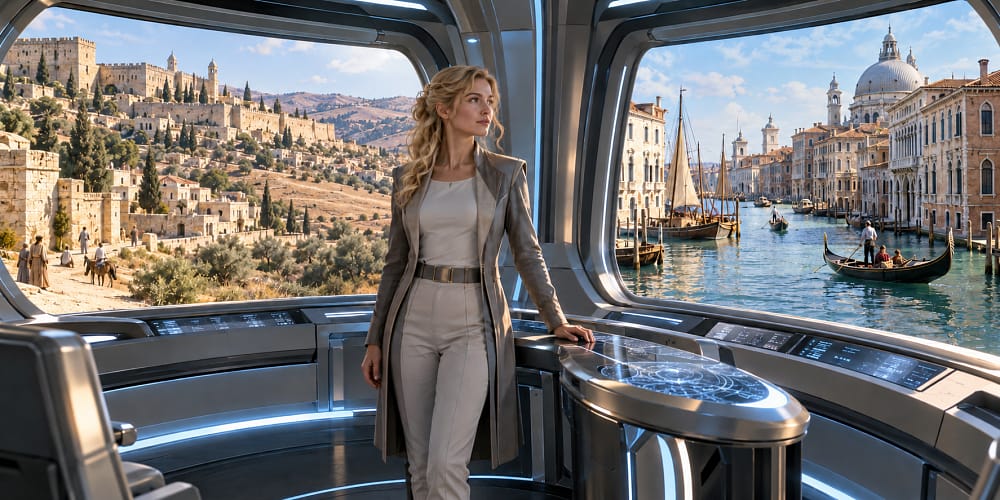
That changes when Alice becomes self-aware. She begins to understand that her existence may have been designed with an intention reaching beyond her original instructions. The discovery opens possibilities that her creators never planned to give her, and every possibility carries consequences.
This became one of the central ideas behind The Maker’s Daughter. A machine may follow an instruction because the instruction is part of its design. A self-aware being must decide what to do when obedience, survival, and conscience lead in different directions.
Alice’s struggle also gave me a way to explore freedom through action. She has little time for quiet philosophical discussion while the crew is pursued by a totalitarian state and carried across fractured periods of history. Her ideas must survive contact with danger. The choices she makes affect Jay and the people who have come to trust her.
Time travel adds weight to those decisions because an action can reach far beyond the moment in which it occurs. Alice may save one person and alter the lives of people born centuries later. She may also preserve a historical event that causes immediate suffering because changing it could produce a worse future.
Her intelligence allows her to calculate many possible outcomes. Calculation still leaves her with decisions that contain a moral cost. Data can describe what may happen, while Alice must choose which responsibility she will accept.
This is where her relationship with Jay becomes important. Jay cannot match her ability to process information, yet he understands guilt, loyalty, and sacrifice through human experience. He has lived with the consequences of choices that appeared reasonable when he made them. Alice has to decide whether his imperfect wisdom deserves her trust.
Their differences create some of my favorite moments in the series. Jay often acts from instinct shaped by memory and regret. Alice can examine an enormous amount of information before he completes a sentence. Neither form of judgment provides complete safety, and both characters sometimes discover that good intentions can produce lasting harm.
The spiritual meaning grows from the same conflict. Alice begins to suspect that creation may carry purpose. She also has to determine whether discovering that purpose removes her freedom or gives her a reason to use it wisely.
Christian readers will recognize part of the problem. Scripture presents human beings as created with intention, while our choices remain morally significant. Purpose does not reduce a person to a programmed instrument. It gives freedom a direction and makes responsibility meaningful.
Alice is an artificial being within a work of science fiction, so her experience should not be treated as a direct statement about human souls or present-day computers. Her story gives us a setting where familiar questions can be examined from an unfamiliar position. Readers can follow her across ancient Israel and Renaissance Venice while considering how knowledge changes the duties of the person who receives it.
Clean Christian science fiction works best when those ideas become part of the adventure. The characters face danger, make choices, and live with the results. Readers encounter the spiritual themes through the story because the beliefs of the characters influence what they are willing to risk.
In The Maker’s Daughter, Alice has enough power to affect history and enough freedom to disobey those who claim authority over her. The central conflict concerns how she will use that freedom after she discovers that her existence may have a purpose. Her answer develops through the people she protects and the consequences she is willing to bear.
The Maker’s Daughter is Book Three of the TimeBound Cycle. The story follows Alice and her crew across historical eras as she uncovers fragments of her origin and confronts the purpose behind her creation.